“Just Eddie”: these are the words that flash up on the screen of my wife’s phone when I call her.
And “Oh, it’s just Eddie”, is what people tend to say when they see me around in Portobello, Edinburgh.
I take it as a compliment: there are no barriers between us.
I’ve been deeply embedded in the community here since I was ordained a deacon aged 42. Now I’m 49, a married man, a father of three, and a maths teacher.
My ministry fits around my family and my work.
Everyone in the parish knows not to expect to reach me between nine and half three in term time.
It’s a good balance – there are quite a few deacons who are teachers or nurses: intensely at work a lot of the time, then free to help the rest of the time. I love being able to say, in the staffroom, “I married an ex-pupil this weekend.”
Beginnings
I grew up in Dundee – a fairly poor area of Dundee – in a council house, the fifth of six children. My father died when I was 13.
He had fallen away from the Church after Vatican II, but my mother was very devout, so I grew up with Church at the centre of my life. I also discovered, quite young, that I was good at maths, so after school I did a degree in pure maths. But if you’d told me then I would go on to do a theology degree, I’d have laughed.
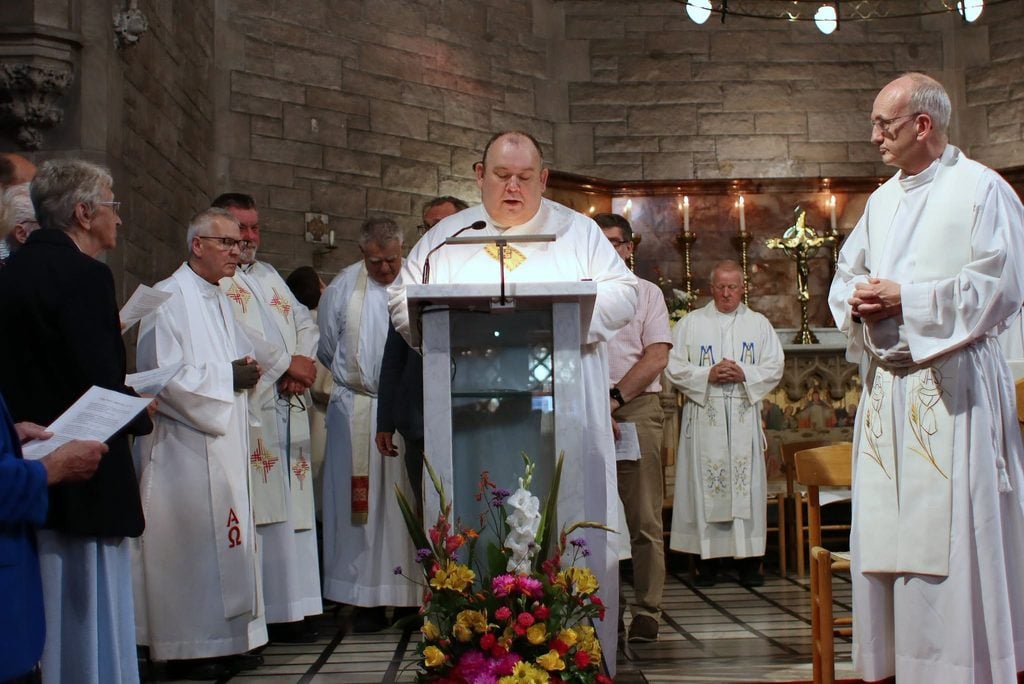
When people ask me about my path to becoming a deacon, I always feel I disappoint them when I don’t come back with some otherworldly story about how God spoke to me one day and asked me to do this.
But really it just wasn’t like that: it was very practical and logical – a mathematical route, if you like. I believe in one God, the Father Almighty. I believe in every part of the Creed. And I believe in the Church.
I also believe that there’s a problem with providing clergy in the Church, and when I was a father of small children I saw that this was something I might help, in a small way, to resolve. It seemed obvious to me that I couldn’t really complain that there weren’t enough priests and deacons in the Church if I sat back and did nothing about it.
There was a great priest here at the cathedral in Edinburgh, Mgr David Gemmell, who died a few years ago.
He used to say that one of the things that really annoyed him was when, at the end of Mass, someone from the congregation would ask: “When are you going to paint that wall?” And he’d say, “Well, I’m never going to paint it. It’s your church: why are you not painting it?” And I think that’s the sort of mindset we need.
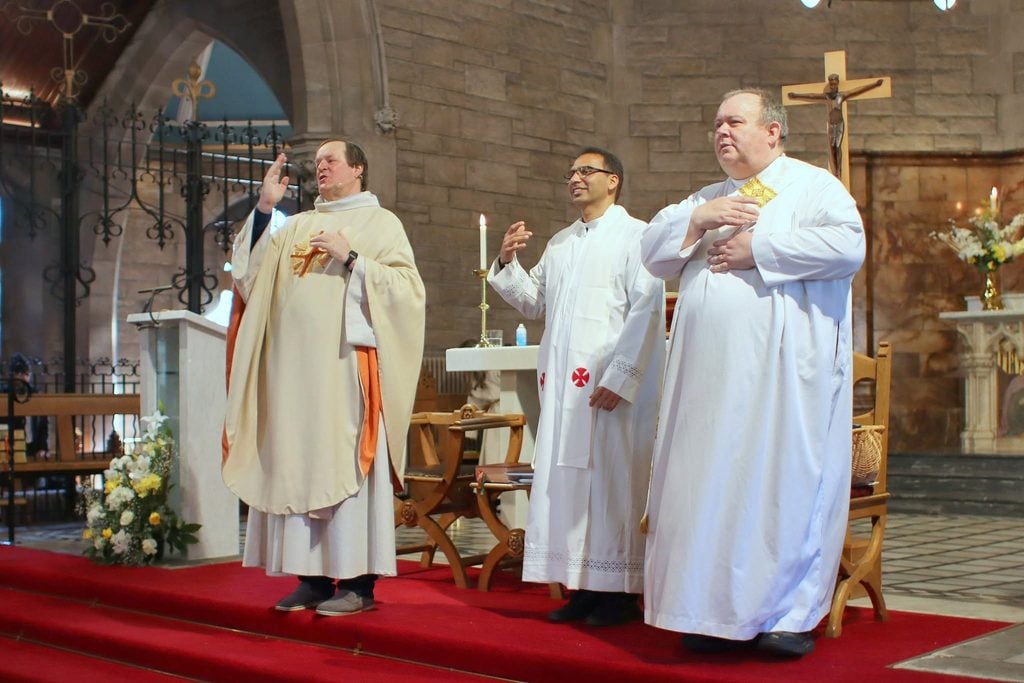
The parish priest is maybe like the managing director of a business, but we’re all in this together.
I never had a feeling that I wanted to be a priest. Some of my slightly less theologically understanding colleagues said: “Why don’t you just become an Anglican now, because Anglican priests are well paid and allowed to be married?”
But it wasn’t as simple as that: I never had a sense that, because I’m not allowed to be a priest, I’m going to be a deacon; rather that the Church needs more deacons, and that’s something I can do.
Support
And I love it that my children are involved in my work. My 16-year-old is a huge support to the sacristan of the church. My youngest, coming up 14, helps with a lady who will be 80 this year, and they go once a week for pizza and coffee, just the two of them.
My wife was fundamentally supportive, but the training, I think, left a lot to be desired. For example, it was largely run by older men who wanted to have an afternoon nap between, say, two and half-four. And those two and a half hours would be added on to the evening – and that, for me, was when I had a two-year-old child, and I should have been helping with bedtime.
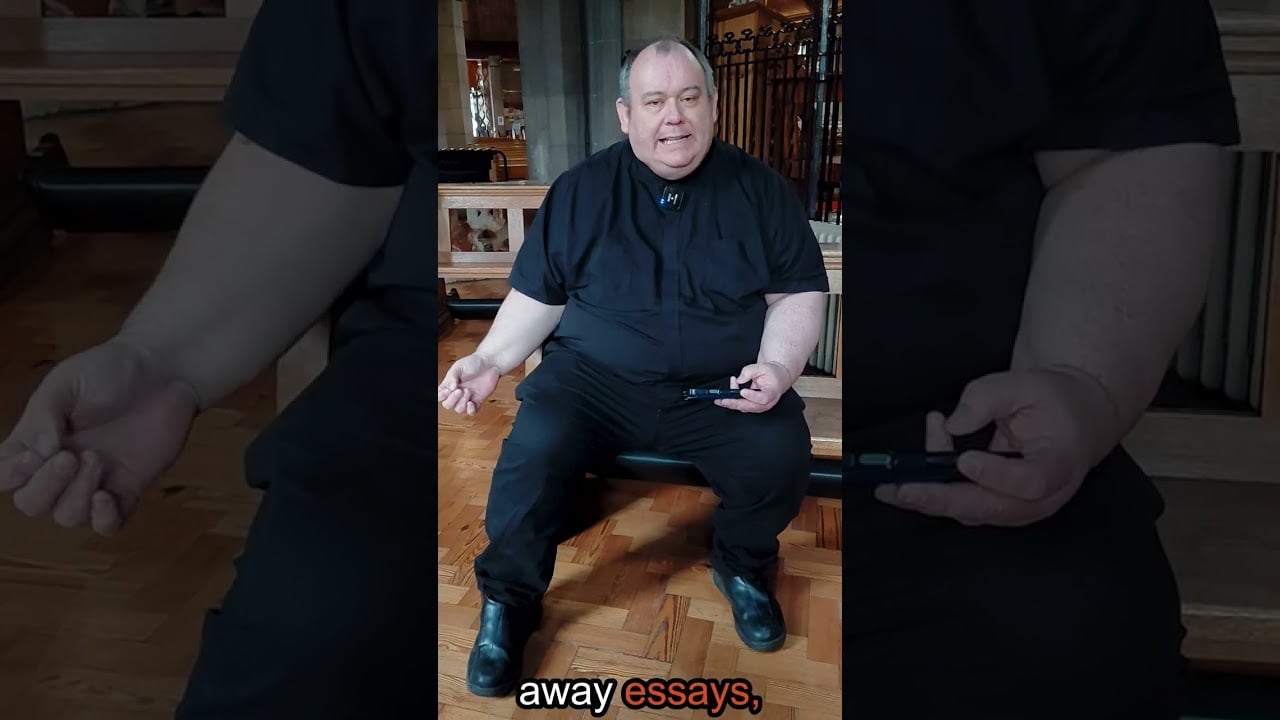
If the Church wants younger deacons – and while retired men without the demands of a job, may be easier to work with in a way, younger deacons will go on longer – they need to develop more of an understanding of what a young family’s life is like.
My work can throw up real challenges.
When Covid hit, and we were about to go into lockdown, I was told I’d be leading the live streaming for the church. I’m quite computer-literate, but I had no interest in audio-visuals – so I had to learn. And now supporting the work of the parish through the internet is something I love.
I did a baptism recently where the family were American, so we were able to livestream to them in America. The children were able to see their grandparents as if they were there with us. Breaking down those barriers is something I really love.
I like to be fully involved in parish life. I love taking baptisms and marriages: who wouldn’t?
And the Eucharist is a very big part of my faith, and I love being able to share this: we have a monthly Benediction and Holy Hour which I run.
And we annually hold our 40 hours of adoration: it was the last thing cancelled before lockdown, and the first thing we started when lockdown was lifted. I do believe that being silent in front of the Eucharist is one of the very best ways of praying.
I’ve been a deacon long enough now that I’m starting to get repeat business from some families. So I feel I must be doing a good job. And they come to me because I’m just Eddie.
As told to Maggie Fergusson. Original article in The Tablet, here. All images: Eliza Veitch. Video: St John’s St Mary Magdalene’s. If you want to find out more about the permanent diaconate in our Archdiocese please contact Deacon Ronnie Macaulay at deaconronnie.macaulay@staned.org.uk. Deacon Eddie is based at St John the Evangelist, Portobello, and St Mary Magdalene’s, Bingham.