Here is the homily of Archbishop Leo Cushley from last night’s Chrism Mass (31 March) at St Mary’s Metropolitan Cathedral, Edinburgh.
The Chrism Mass is the annual liturgy in which priests renew their promises and the Archbishop blesses the holy oils used in the sacraments throughout the year.
“My dear friends, it’s lovely to be able to welcome you to our mother church for the Chrism Mass, a truly diocesan-wide event with people and clergy from all over St Andrews & Edinburgh.
Last year, as we celebrated our Chrism Mass, Pope Francis was still with us, and we were celebrating a Jubilee Year of Hope.
A year later, we gather as we are becoming accustomed to the guidance and insights of his successor, Pope Leo.
We remember with gratitude all that Pope Francis did for us, and we accompany Pope Leo with our prayers for his ministry in these less than happy times: we look around the world for steady and purposeful political insight and leadership, and I for one find it lacking.
We therefore accompany the Holy Father with our prayers as he works towards the restoration of peace and stability among the concert of nations, promoting a renewed pursuit of the global common good, the rule of law, a serious, disinterested political vision and personal integrity among those who aspire to leadership.
St Gregory the Great
Not every leader, however, longs to be in charge. The story of St Gregory the Great is a case in point. Gregory was pope around 600 AD, and he lived in very turbulent times.
Rome was in political upheaval and threatened on many sides by enemies. Gregory was originally a public official. He was also a devout Catholic Christian.
He was dismayed by the politics of his time, and decided to give it all up and become a monk, and tradition has it that he became a Benedictine.
He did not have long to wait, however, before the clergy and people of the diocese and the officials of the city of Rome called upon him to become their bishop.
So, he left the cloister and took charge of Rome as its spiritual leader, but also as the only political figure of any weight or worth in the city.
Gregory was energetic and successful in his endeavours, but, he tells us himself, at significant personal cost: the cost of his serenity, his prayer life, and his distance from the world and its affairs that he so desired.
Nonetheless, he was an inspired choice, as he brought his talent and experience both from government and from the monastery to the governance of the city and the Church of Rome.
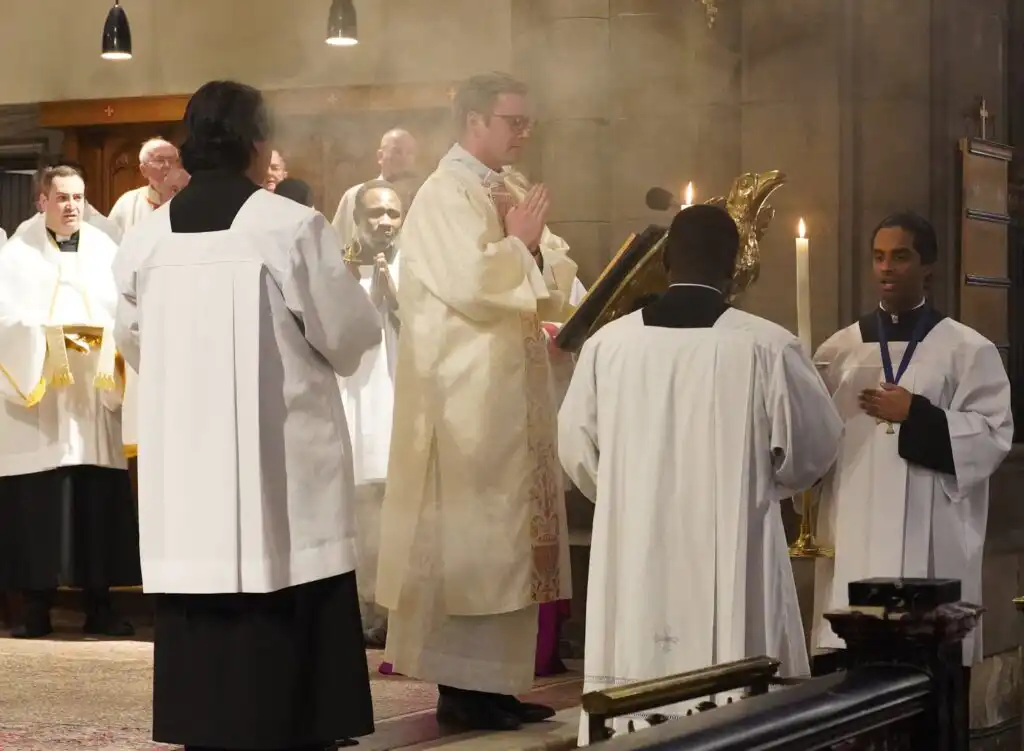
Deacon Matthew McCafferty from Bathgate, reads the Gospel. He is set to be ordained to the priesthood in July.
Of many things, big and small, that Gregory influenced for the better, we have for example the institution of regular Sunday homilies thanks to him.
He insisted that the clergy preach on a Sunday… Now, the quality may not always be of our best, but we up here do endeavour to say something useful, instructive, interesting – and brief. (Incidentally, if one comment from Pope Francis’ pontificate survives, perhaps it will be his instruction to us to preach for no more than seven minutes…).
But back to Gregory: he took the liturgy seriously and he is credited with important reforms there too, in prayers and music.
He has left us many homilies and letters, and his writings were closely studied for the next thousand years throughout Europe, partly because here was a leader who could set an example for bishops, kings and princes alike.
King Alfred of the burnt cakes famously had Gregory’s works translated into English and spread throughout his kingdom to help pastors and civic leaders to govern with Christian justice and compassion.
Servant leaders
But one of the simplest and most famous insights of Gregory to come down to us is also one of his best. He had been a leader in different worlds, and he knew the difficulties of it, the vanities of it, the temptations of it.
He knew what it was to be a leader, and to be a Christian leader.
And so, famously, when describing himself, he would say, “Gregory, a bishop, a servant of the servants of God”.
This simple phrase is used to this day by the Popes of Rome to describe themselves, and it contains a profoundly important message to all of us in Christian leadership, whether you’re sitting up here, or you’re sitting in the pews. All of us lead by example, clergy and people alike.
We all lead others in some way, for better or for worse. But what if it were for the better?
What if leaders, in politics, in the Church, learned again to see leadership as service?
After all, isn’t true leadership in reality a service, not a service to yourself, or your vanity, or your bank account, but a real service to others? Isn’t this what Jesus, our High Priest, whom we celebrate today in our Chrism Mass, did on the Cross?
St Gregory the Great was a servant of the servants of God.
Pope Francis, washing the feet of prisoners, showed himself to be a servant leader. We hope and pray that Pope Leo will set a similar example.
But we your clergy, especially your priests, are called to that servant leadership too.
Servant leadership for us means that we make certain sacrifices: we give up intimacy and a family of our own, our own comfort, our own decision making, and all in order to serve you.
It is leadership, but it is meant to be servant leadership. We are therefore to be men of our word: if we say we’ll do a thing, then we ought to do it.
As in Jesus’s parable, we are to be men who count the cost of the promises we will make before we make them, and then be men enough to live up to our promises. We are called to be men of integrity, not people who say “Yes, Lord”, but who then don’t show up.
Much is given to us, and much is expected of us. To be a servant leader is something that all of us are called to be from time to time.
But it is given to you, my brother priests, to be publicly, permanently, men of integrity, men who keep their promises.
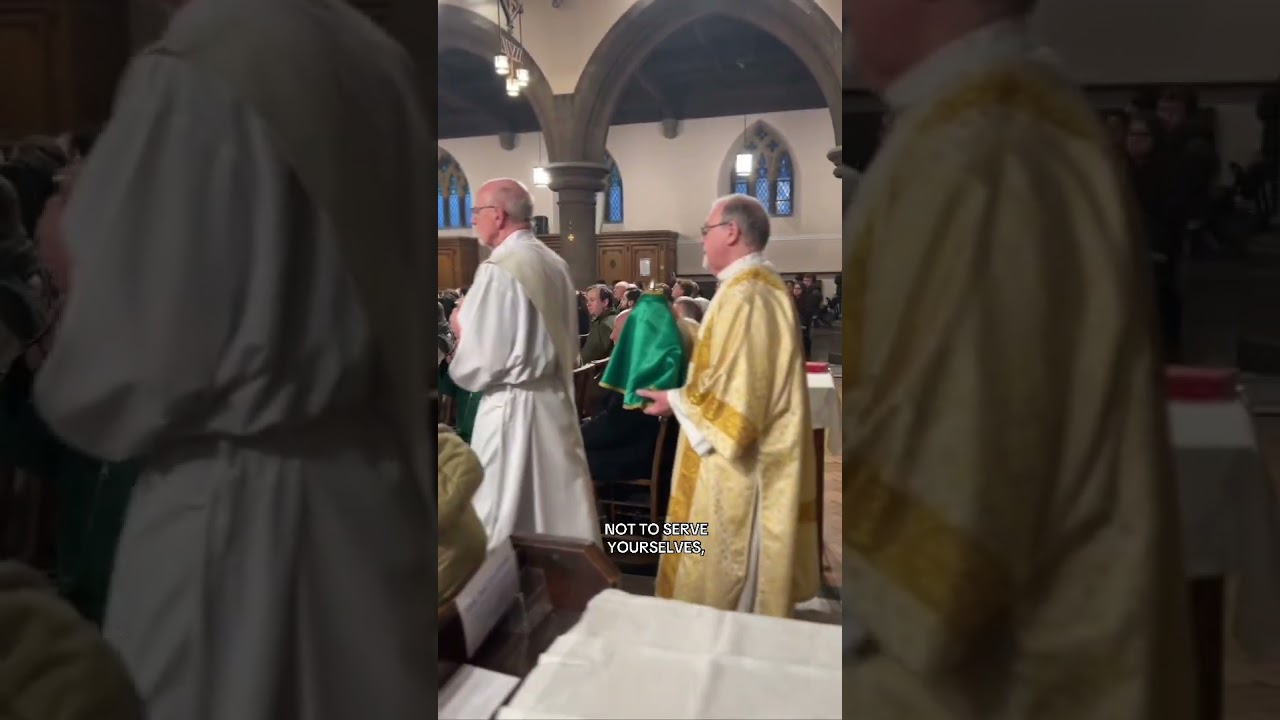
You are called to be leaders: not to help yourselves, but to help others. Not to serve yourselves but to serve others.
Priestly promises
In your priestly promises, you agreed to do something that is challenging and demanding. But it is also something worthwhile, worthy of note and worthy of respect when you fulfil it.
This is why people pay you respect: not because of any inherent or personal dignity that we have, but because you work at it, you go the extra mile, you dig deep for the sake of others.
Because you do it cheerfully. Because you show up and stick it out when you say you will.
And, with God’s grace and the support and affection of His people, our lives will be, should be, ones of goodness, serenity and peace.
Some of you may remember that Pope Francis gave me a letter before I started here in Edinburgh. I haven’t looked at it for a while, but three words in it have stuck with me.
He said, No matter what’s happened today, good or bad, you should be able to go home, pray before the Lord, and say, “Content, Lord, content”.
This felt like very personal advice from someone who was then just five months into being pope. But they strike me as good, wise words for us all as priests.
If we have done a day’s service for others, for their good, not ours, for their health, not ours, for their happiness, not ours, we too should be able to say, “Content, Lord, content”.
The world these days badly needs servant leaders, leaders with the good of their people at heart.
Let me thank you, my brother priests and deacons in service in St Andrews & Edinburgh for all that you do, seen and unseen, appreciated and unappreciated, for all those around you.
May your service and leadership be blessed the Lord abundantly; and may we all celebrate a joyful and blessed Easter, united in the service of Christ, our High Priest. God bless you all!”